




No10 advisers push for early general election as they feel confident of Labour majority

Downing Street advisers and some Labour MPs are privately pushing for an early general election next spring, despite the Prime Minister’s repeated insistence that he has no plans to go to the polls ahead of schedule.

Senior figures close to Andy Burnham are understood to believe that an election in spring could offer Labour its strongest opportunity to secure another parliamentary majority, although the idea remains contested within government.
One senior government source described the views on timing as a “diverse opinion across Government”, while warning that Labour would be “naive not to be contemplating all scenarios”.
The argument for an early contest centres partly on the restrictions imposed by Labour’s 2024 manifesto.
Supporters of an election believe its commitments on taxation, fiscal rules and Britain’s relationship with the European Union have constrained the Government’s room for manoeuvre.
A source told the Telegraph: “There are lots of things we can do within the red lines of the manifesto, but that is not the Prime Minister’s manifesto.
"I am sure there are lots of things Andy would want to include in a manifesto that he wouldn’t be able to do at the minute.”
A second source said some Downing Street advisers and Labour MPs were encouraged by the party’s current two-point lead over Reform UK in polling and wanted to consider whether that advantage could be translated into an electoral mandate.
However, supporters of an early election believe the conflict in the Middle East would need to have eased, energy costs would need to be falling, and the Government would need to demonstrate a series of popular policy achievements, before an election could be seriously contemplated.

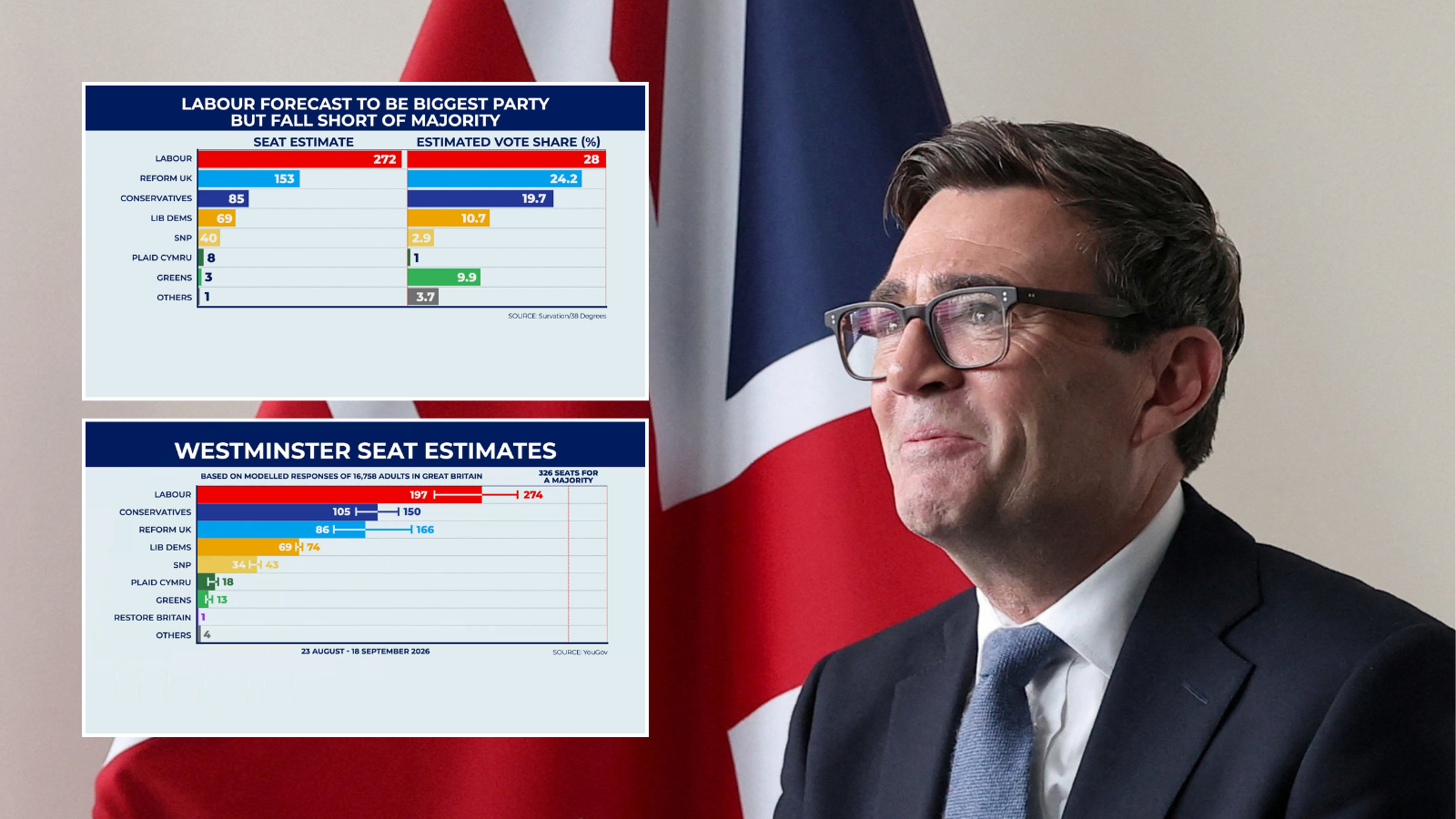
A YouGov constituency-level poll published today suggested Labour would remain the largest party if an election were held immediately, but would fall 85 seats short of an overall majority.
The multilevel regression and post-stratification survey, first reported by The Times, projected Labour winning 241 seats, compared with 130 for the Conservatives and 123 for Reform.
While the Liberal Democrats were projected to take 71 seats and the SNP 40.
The findings raise the possibility of Labour needing support from other parties to remain in government, with sources close to SNP leader John Swinney claiming the party could demand a second independence referendum in return for supporting a minority Labour administration.
They said Mr Burnham would have to give Scots the “right to decide their own future” by transferring powers to Holyrood, allowing the Scottish Parliament to determine when a referendum should take place.
LATEST DEVELOPMENTS
- Andy Burnham handed £14.3bn plan to rewire England's 'failing' housing benefit system
- Nigel Farage accuses Labour of 'losing control' after minister admits not every boat can be stopped
- Kemi Badenoch doubles down on 'common sense' benefits crackdown in GB News grilling

Liberal Democrat sources also failed to rule out a confidence-and-supply arrangement or coalition, although they said the party would not be “distracted by hypotheticals”.
The Conservatives could also benefit politically from an election, by arguing that an improved result demonstrated they had overtaken Reform as the principal party on the Right.
The speculation comes shortly before Labour’s annual conference in Liverpool, where Mr Burnham is expected to set out his “10-year plan” for government.
Despite the renewed discussion, the Prime Minister has repeatedly ruled out an early election.

Some allies also fear that losing Labour’s current majority would be interpreted as an electoral setback.
The conference will be followed by Mr Burnham’s first Budget on October 28, with tax rises expected.
During a visit to the United Nations this week, the Prime Minister said he remained “conscious of the extent to which Labour has raised revenue” in its previous two Budgets, while stressing the need to ensure the Government had got “the balance right” between taxation on income and wealth.
A No10 source sought to end speculation over an imminent election, telling The Telegraph: “One person in Downing Street makes the decision and he has ruled out an early election.”
Our Standards: The GB News Editorial Charter