






France tells police not to stop illegal migrants in shallow waters

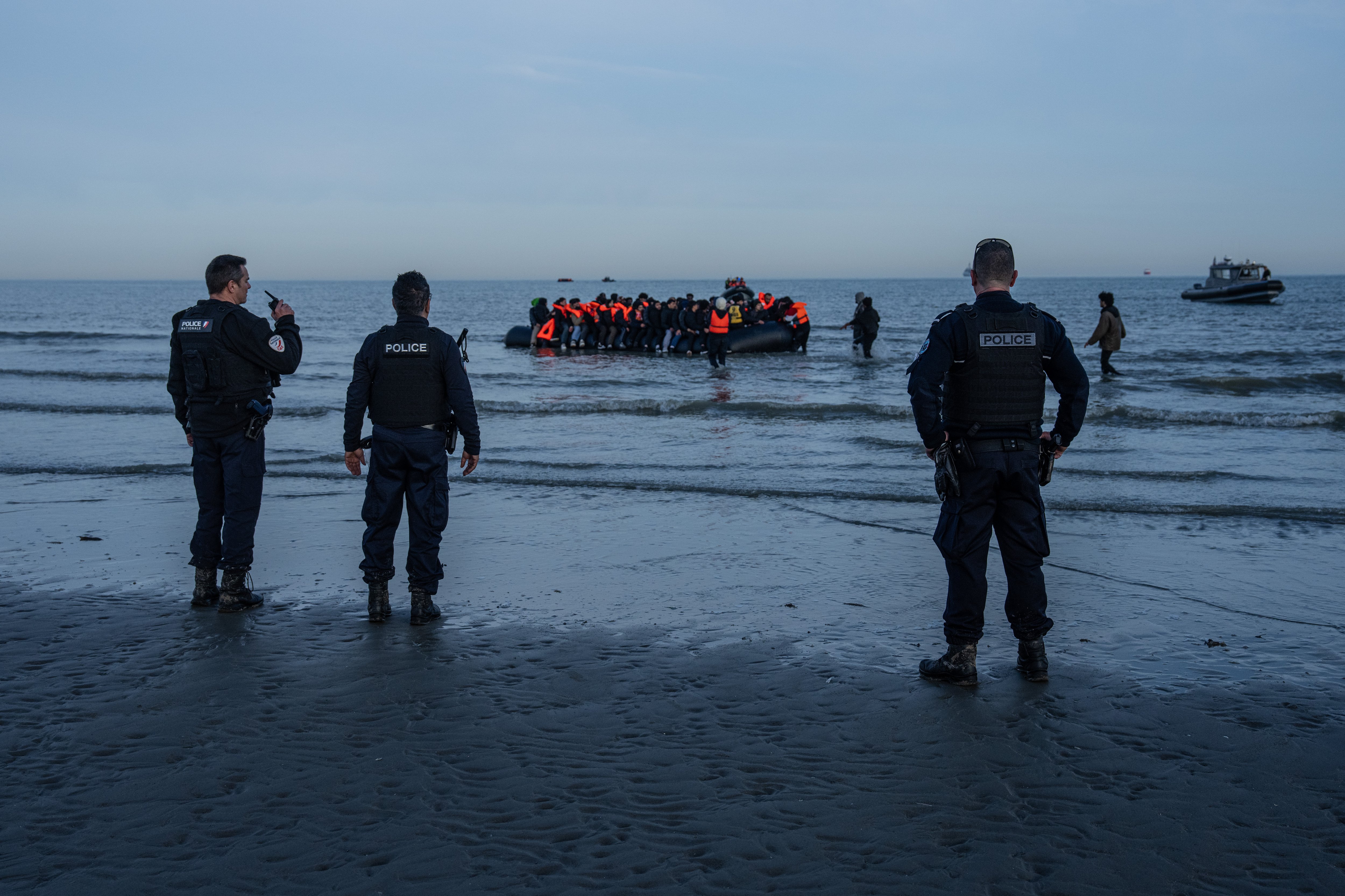
Laurent Nunez, France's interior minister, has declared French officers are forbidden from entering shallow waters to prevent migrant dinghies from departing, insisting their role is to protect lives rather than endanger them.

Appearing before a parliamentary commission examining UK-French migration treaties, Mr Nunez branded the practice of deflating boats near the shoreline as wholly unacceptable.
He went further by ruling out any scenario in which British vessels could bring migrants back to French beaches, saying such action would constitute a violation of French sovereignty.
The remarks amount to a direct challenge to Reform UK's flagship immigration policy, under which Nigel Farage's party has committed to deploying the Royal Navy to intercept Channel crossings and transport migrants back to France should it come to power.
These declarations arrived during a particularly intense week for Channel crossings, with 1,129 people making the journey over just four days. Wednesday alone saw 781 arrivals, establishing a new single-day record for 2026.
The year's cumulative total of 18,579 migrants represents a decline of more than 40 per cent when measured against the equivalent period in 2025.
Mr Nunez outlined a strict operational doctrine permitting action only within two defined frameworks.
The first allows officers to physically prevent migrants from reaching the water while still on land. The second authorises a recently established specialist police unit, trained specifically for maritime operations, to intercept the so-called taxi boats operated by people-smuggling networks at sea.
Beyond these two scenarios, he made clear, no police or gendarmerie intervention is sanctioned once individuals have entered the water.

Speaking to the commission, Mr Nunez spelled out the boundary between land and sea operations with precision.
"On the boundary between what is at sea and what is on land, I would say that there is no intervention by the police or the gendarmerie once people are in the water," he said.
The sole exception, he explained, applies when officers witness a vessel capsizing, at which point they may step in to carry out a rescue.
He stressed that maritime interceptions fall under an entirely separate chain of command.
"The doctrine for intervention at sea is a different matter; it is an operation carried out under the authority of the maritime prefect under extremely strictly defined conditions," he said.
This newer maritime protocol has been deployed roughly ten times since its introduction several months ago, according to Nunez, who emphasised that saving lives remained the overriding priority in every operational scenario.
LATEST DEVELOPMENTS:
- Lisa Nandy defends Labour's small boats strategy after record number of single-day crossings: 'It is working'
- Afghan asylum seeker who masterminded £181MILLION phone smuggling operation jailed
- Angela Rayner swipes at Shabana Mahmood over migrant visas as Labour war reignites

Chris Philp, the shadow home secretary, responded with a blistering attack on the French position.
"This confirms what a French gendarme admitted to me on a beach a few weeks ago French land forces will stand by and do nothing while illegal immigrants embark in knee-deep water," he said.
Mr Philp argued that the policy of non-intervention was itself lethal.
"Some of them later drown so not intervening is actually causing people to die" he added.
"I have stood next to a boat launching in shallow water and they could easily be safely stopped, as the Belgians do."
He also accused Paris of reneging on commitments made to the British Government.
"The French Government is openly defying Shabana Mahmood. President Macron promised back in July 2025 he would change the French law to allow intervention in shallow water but nothing has changed," Mr Philp said.
When commissioners questioned Mr Nunez about footage appearing to show officers wading into the surf to puncture a small boat, he distanced himself entirely from the practice.
"Regarding the actions you mention, which allegedly involve damaging boats to prevent them from setting sail again, I repeat that our priority is saving human lives. I am not aware of such practices, which are unacceptable," he replied.
Our Standards: The GB News Editorial Charter